Overview
falcorcomp is a collection of Monte Carlo renderers for computational imaging, built on the NVIDIA Falcor rendering framework. It is not a general-purpose renderer: it provides render passes that simulate active sensing systems, which light the scene themselves and measure what comes back, such as time-of-flight cameras and structured light.
falcorcomp is performance-oriented: all renderers run on the GPU with hardware ray tracing, fast enough for interactive, real-time simulation as well as for offline rendering. falcorcomp is installed as a Python package and driven from Python scripts.
What it renders
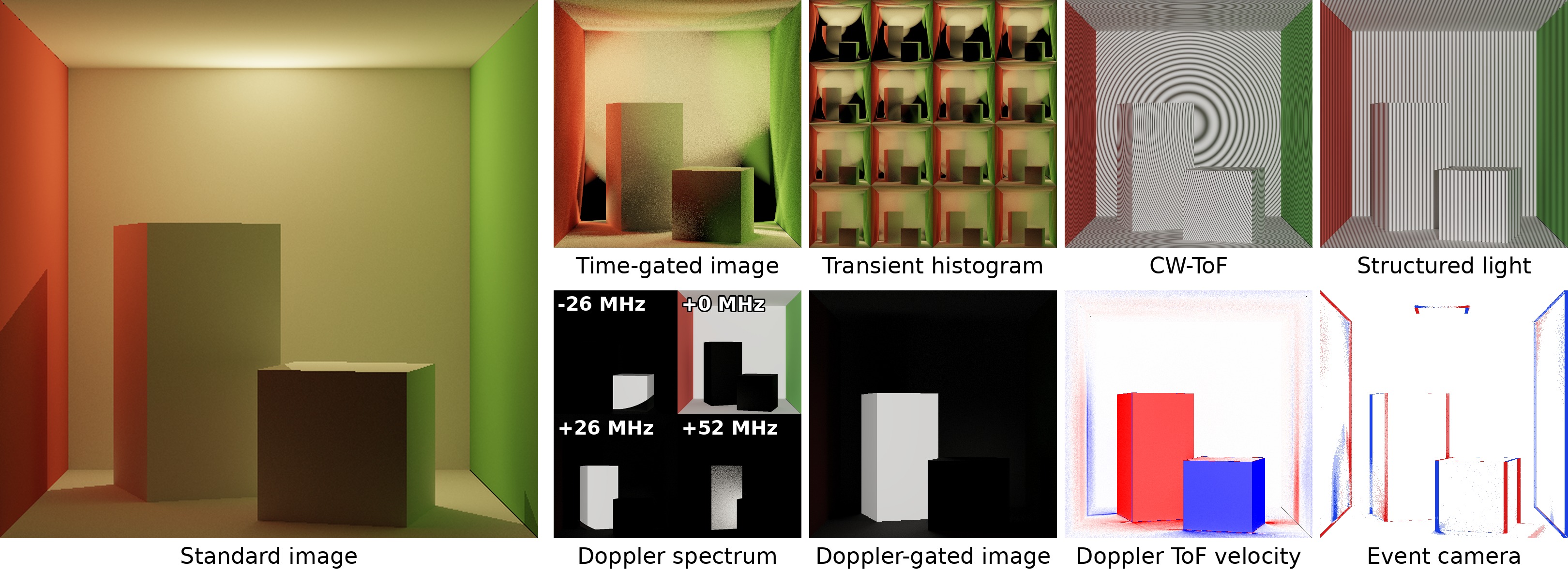
The Cornell box rendered with falcorcomp. Left: a standard image. Top row: a time-gated image, a transient histogram (16 of its 64 bins), and CW-ToF and structured-light measurements. Bottom row, with the tall box approaching and the short box receding: the Doppler spectrum of optical heterodyne detection (4 of its bins), a Doppler-gated image (only the light shifted by about +26 MHz: the tall box), the velocity estimated from Doppler ToF measurements (red approaching, blue receding), and the events of a camera moving right (red brighter, blue darker). The settings follow the tutorials. Measurements as path integrals gives the path integral of each.
Time-of-flight (ToF): a laser lights the scene, and the measurement depends on the total length of each light path (laser -> scene -> camera), which sets its arrival time.
Measurement |
Output |
Render passes |
|---|---|---|
Time-gated image |
|
|
Transient histogram |
|
|
Modulated light: the light varies in time or in space, and the measurement weights each path by that modulation.
Measurement |
Modulation |
Render pass |
|---|---|---|
Continuous-wave ToF |
a periodic function of the path length |
|
Structured light |
a projected pattern |
The ToF measurements have a path tracer and a ReSTIR renderer each. The ReSTIR renderers reuse the paths found by neighboring pixels and by earlier frames, moved to each pixel with a path-length-aware shift mapping, which pays off when few sampled paths fit the measurement, such as with a narrow time gate or in online rendering. The modulated-light renderers support antithetic sampling, which pairs every sampled path with a nearby one of opposite modulation, so that the indirect light cancels the way it does in the real measurement.
Doppler: the measurement depends on how fast each path’s length changes as the scene moves (with FMCW, also on the length itself).
Measurement |
Output |
Render pass |
|---|---|---|
Doppler-gated image (OHD) |
|
|
Doppler spectrum (OHD) |
|
|
FMCW spectra (OHD) |
|
|
Doppler ToF |
|
Event cameras: each pixel reports when its brightness \(\log(I_\epsilon + I)\) changes by more than a threshold.
Measurement |
Output |
Render passes |
|---|---|---|
Brightness change and events |
|
How it is used
A script loads a scene, builds a Falcor render graph around one of the render passes and renders frames with it:
import falcorcomp as falcor

testbed = falcor.Testbed(create_window=False)
testbed.load_scene("cornell-box/scene-v4-nolight.pbrt")
testbed.resize_frame_buffer(512, 512)
testbed.scene.camera.aspectRatio = 1.0

graph = testbed.create_render_graph("TimeGated")
graph.create_pass("VBuffer", "VBufferRT", {})                     # primary hits
graph.create_pass("Laser", "LaserLight", {                        # the laser
    "laserPosition": [0.0, 1.7, 6.8], "laserDirection": [0.0, 0.0, -1.0],
    "laserPower": [170.0, 120.0, 40.0],
})
graph.create_pass("Tracer", "TimeGatedPathTracerInline", {        # the ToF render pass
    "samplesPerPixel": 16, "maxBounces": 6,
    "timeGateWindow": 0.1, "timeCenter": 17.337,
})
graph.add_edge("VBuffer.vbuffer", "Tracer.vbuffer")
graph.add_edge("Laser", "Tracer")                                 # run the laser pass first
graph.mark_output("Tracer.color")
testbed.render_graph = graph

testbed.frame()                                                   # one noisy frame; average many for a clean image
image = graph.get_output("Tracer.color").to_numpy()               # 512 x 512 x RGBA
A pass’s settings can also be changed between frames, with the names used to create it:
graph.get_pass("Tracer").set_properties({"timeCenter": 17.6}). Settings left out keep their
values, an invalid value raises an error and leaves the pass unchanged, and
graph.get_pass("Tracer").properties returns the current settings.
The same graph can run in an interactive window, where the camera and the render pass’s settings can be changed while it renders. The tutorials build such graphs step by step, and the plugin reference describes every render pass and its settings.
Differences from Falcor
falcorcomp changes two behaviors of Falcor itself, which also show in Falcor’s own render passes:
pbrt scenes keep pbrt’s materials. Falcor’s pbrt importer converts materials to its
StandardMaterialunless its settingPBRTImporter:usePBRTMaterialsis on; falcorcomp turns it on by default, sodiffuse,conductor,dielectric,diffusetransmission,coateddiffuseandcoatedconductorkeep pbrt’s BSDFs (thindielectricis still converted).Testbedloads scenes with the default; in Mogwai,m.addOptions({"PBRTImporter": {"usePBRTMaterials": False}})before loading a scene restores the conversion.pbrt materials report an albedo for denoising. In Falcor, the pbrt
conductor,dielectricandcoateddiffusematerials report no diffuse albedo (zero). SVGF-style denoisers divide by that albedo (demodulation), so falcorcomp reports one: the reflectance at normal incidence forconductor, 1 fordielectricand the base layer’s reflectance forcoateddiffuse. Everything that reads the albedo sees it: the path tracer’s albedo and NRD guide outputs, the G-buffer’s diffuse albedo and RTXDI. Acoatedconductorstill reports none, so SVGF andEventSVGFcannot demodulate it.
Research
falcorcomp includes the implementations of these papers:
ToF ReSTIR: Time-of-Flight Rendering with Spatio-temporal Reservoir Resampling, SIGGRAPH 2026 (ACM TOG). Project page. The ReSTIR render passes for time-gated and transient rendering.
Difference-aware Filtering for Event Camera Simulation, EGSR 2026 (Computer Graphics Forum). Project page. The
EventSVGFrender pass: low-sample event camera rendering.Geometric Antithetic Sampling for Spatiotemporally Modulated Light, SIGGRAPH Asia 2026. Project page. Antithetic sampling in the CW-ToF and structured light render passes.
A Monte Carlo Rendering Framework for Simulating Optical Heterodyne Detection, SIGGRAPH 2025 (ACM TOG), honorable mention. Project page. The OHD path integral behind the Doppler spectrum and Doppler-gated render passes.
Doppler Time-of-Flight Rendering, SIGGRAPH Asia 2023 (ACM TOG). Project page. The Doppler ToF render pass.
If falcorcomp is useful in your research, please cite the corresponding papers; the BibTeX entries are in the README.
Next steps
Installation: install the Python package.
Tutorials: render time-gated images, transient histograms, CW-ToF and structured light measurements.
Advanced tutorials: ReSTIR and ellipsoidal sampling.